
To run your first 100-mile race: give yourself 12–18 months from your first marathon, step up through a 50K and 50-miler, train 5–6 days a week by time (not miles), run at least 9 hours a week for 6 weeks at peak, practice your race-day fueling 6+ times, line up 3–4 crew and 2–3 pacers, taper for 3 weeks, and plan 2 weeks of recovery afterward.
Some links are affiliate links. I only recommend gear I actually use.
My journey to 100 miles
I've now run seven 100-milers, including Leadville twice, plus three 200-milers. But I started where a lot of people start: a half marathon. Here's how I got from there to my first 100.
| When | Distance |
|---|---|
| September 2018 | First half marathon |
| October 2018 | First marathon |
| December 2019 | 52 miles |
| May 2020 | 60 miles |
| November 2020 | 100 miles |
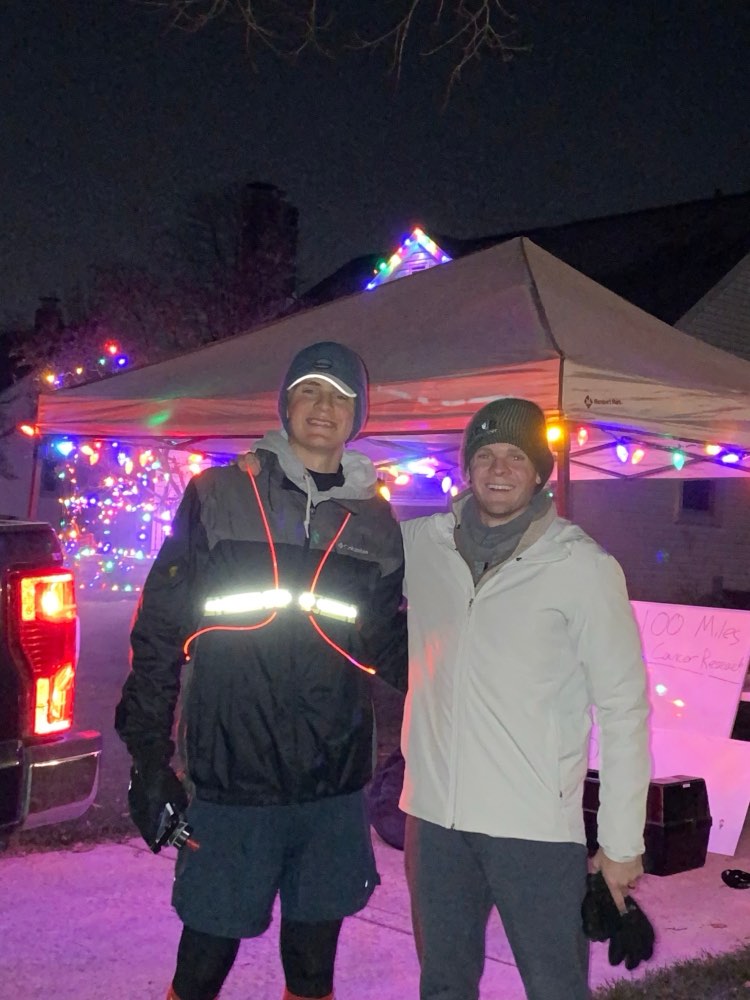
My first 100 was on November 28, 2020, for childhood cancer research. No coach, no plan, just a 1.02-mile loop around my neighborhood that I ran 100 times.
Looking back, I could have moved through that progression faster. I just didn't know what I didn't know. That's why I wrote this guide: everything I wish I'd had, in one place. (For the specific mistakes I made, read what I wish I knew before my first 100-mile race.)
1. Pick your distance and your race
If you haven't run an ultra yet, don't jump straight to 100. This is the progression I use with athletes:
- Half marathon
- Marathon
- 50K
- 50 miles
- 100K
- 100 miles
When it's time to pick your 100, these are the factors I look at:
- What excites you most? You'll train for this race for a year. Pick one you genuinely want to run.
- Elevation gain. Less climbing means a more runnable race.
- Temperature. Heat and cold both change everything about race day.
- Cutoff times. More hours means more margin. Most beginner-friendly 100s allow 30–32 hours.
- Altitude. Racing near sea level is a lot easier than racing up high.
- Terrain. Smooth trail is very different from rocky, technical singletrack.
- The date. Make sure it gives you enough time to train.
Go deeper: how to find an ultramarathon near you and the best 100-mile races to get your first buckle.
2. Give yourself 12–18 months
I advise athletes to take 12 to 18 months from their first marathon to train for a 100 the right way. That gives you time to build your base, run a 50K and a 50-miler, learn your fueling, and arrive at the start line healthy.
Before you even start a structured block, you should have 4–6 weeks of easy running under your feet. Then plan the year as a whole: put your 100 on the calendar, work backward, and drop a 50K and a 50-miler in along the way as training races.
Set two kinds of goals:
- Outcome goal: the result you want. Example: finish my 100 in under 24 hours.
- Process goals: the habits you control that get you there. Example: eat every time my fueling timer goes off, complete all my long runs, and plan my week every Sunday.
3. How to train for a 100-miler
Run 5 to 6 days a week, and program your training by time, not miles. Terrain changes your pace too much for mileage to be reliable. Most of your running should be easy and conversational. Here's how I structure a training year.
The four phases
- Base: easy, aerobic running. Volume increases and you establish your weekly rhythm.
- Build: harder workouts come in (VO₂ max and threshold). Volume keeps climbing, and you add more climbing and descending.
- Specificity: race-specific endurance. Your longest runs, plus dialing in terrain, elevation, fueling, and heat or altitude.
- Taper: 3 weeks of cutting back before race day (more on that below).
The three training blocks
The general rule: the less race-specific the work, the further from race day it goes. Fast, intense intervals come early. Long, race-like efforts come late.
| Block | Effort | What it looks like | Length |
|---|---|---|---|
| VO₂ max | Hard (8–9 out of 10) | Short intervals of 30 sec–4 min with equal recovery. 12–15 min total at effort, e.g. 12 × 1 min hard / 1 min easy. | 2–4 weeks |
| Lactate threshold | Comfortably hard (6–7) | Intervals of 4–20 min with half as much recovery. 20–60 min total at effort, e.g. 3 × 8 min / 4 min easy. | 4–8 weeks |
| Endurance | Mostly easy (2–3) | Back-to-back long runs, race-terrain simulations, steady efforts (4–5) and vertical training. Ends with your taper. | 6–10 weeks |
Why the VO₂ max block? Ultras are run at low intensity, but your VO₂ max sets the ceiling for how efficiently you run at every lower effort. It's the least race-specific block, but it's foundational.
Why threshold? It gives ultrarunners the biggest return on investment. It teaches your body to clear fatigue more efficiently, so you can run longer with less effort.
Why the endurance block? This is where you prepare for your race. It's not about pace. It's about durability and getting your terrain, elevation, climate, fueling and pacing ready for race day.
How much to train at peak
| Race | Peak long run | Peak weekly running |
|---|---|---|
| 50K | 20 miles | At least 6 hrs/week for 3+ weeks, starting 6 weeks out |
| 50 miles | 30 miles | At least 6 hrs/week for 3+ weeks, starting 6 weeks out |
| 100K | 40 miles | At least 9 hrs/week for 6 weeks, starting 9 weeks out |
| 100 miles | 40 miles | At least 9 hrs/week for 6 weeks, starting 9 weeks out |
Those peak weeks lead straight into your 3-week taper. For a 100-miler, that means at least 9 hours of running every week from 9 weeks out until 3 weeks out, then you start cutting back.
For your first 100, you don't need tons of 30-plus-mile runs. Long runs peak around 40 miles, and a 50-mile race earlier in your block makes a great tune-up. Want to see a real peak week? Here's an actual week from one of my athletes (about 12 hours and 65 miles).
Train for your course's climbing
Match your weekly climbing to your race with this formula:
- Average gain per mile = course elevation gain ÷ course miles
- Weekly climbing target = average gain per mile × your weekly miles
Example: a 100-miler with 10,000 ft of gain averages 100 ft per mile. In a 60-mile week, aim for about 6,000 ft of climbing. Train the downhills too. Descending is what wrecks most people's legs.
My training priorities, in order
- Cardiovascular fitness: always first.
- Climbing and descending: train both up and down.
- Nutrition and gut training: practice race fueling 6+ times.
- Long runs: scaled to your race distance.
- Race-specific surface: train on what you'll race on, whether that's road, smooth trail or technical trail.
- Other stressors: heat, altitude and overnight running. If your race goes overnight, do at least one dusk-to-dawn training run.
Not everyone has access to mountains, technical trail or altitude, and that's okay. Focus on the top of this list, and do what you can with the rest. Treadmill incline and stairs can stand in for hills.
Rules I program by
- 3 weeks of building, then 1 easier week to recover.
- Never increase volume and intensity at the same time.
- As the plan progresses, intensity comes down and time at intensity goes up.
- Put the hardest workouts first in each block.
- 80% consistency is the goal. Missing a session is not the end of the world.
- Track three things: weekly time, weekly climbing, and how you feel after each workout.
Common training mistakes
- All volume, no intensity. Ultras still need intensity.
- Ramping volume and intensity at the same time.
- Not training specifically enough for your race's terrain, elevation, heat and fueling.
4. Practice your fueling
Practice your race-day fueling at least 6 times, on long runs of 4–5 hours or more. Your gut is trained just like your legs. Start here and adjust:
| Per hour | Starting point |
|---|---|
| Calories | 200–300, mostly from carbs |
| Water | 16–32 oz, adjusted to thirst and heat |
| Sodium | 600–800 mg per liter of fluid |
Look for fuel that mixes glucose and fructose (about a 2:1 ratio). Your body can absorb more carbs per hour that way. And set a timer. "Eat when the timer goes off" is one of the best process goals you can have.
For caffeine, start around hour 12 with 50–100 mg, then take 100–200 mg every 3–4 hours depending on your tolerance, after testing it in training. More on that in what I wish I knew before my first 100.
5. Get your gear
The must-haves for your first 100:
- Shoes you've tested in training, plus a backup pair.
- Toe socks, several pairs.
- A hydration vest that holds 1.5–2 liters.
- A GPS watch with 24+ hours of battery.
- A headlamp plus a backup.
- Layers for the overnight temperature drop.
- Anti-chafe balm, like Salty Britches, and a small blister kit.
The full list, with my exact picks and a printable checklist: 100-mile race gear checklist.
6. Build your crew and pacers
For your first 100, I recommend 3–4 people on your crew and 2–3 people who can pace you.
- Your crew meets you at aid stations with your food, gear, dry socks and layers. Give them a crew cheat sheet: what you'll need at each stop, so they're ready before you arrive.
- A pacer is someone who runs with you, typically after you reach the 50-mile mark. They keep you moving, remind you to eat, and keep you company through the night. Check your race's rules for exactly where pacers can join.
7. Taper and race week
Taper for 3 weeks. Cut volume, not all of your intensity.
| Week | Volume |
|---|---|
| 3 weeks out | About 70% of your peak |
| 2 weeks out | About 50% of your peak |
| Race week | Mostly rest, with short shakeout runs |
Keep a few short, quality sessions in so your legs stay sharp. In race week:
- Reread the course information: aid stations, cutoffs, where crew and pacers can meet you.
- Nail down your nutrition plan.
- Prioritize sleep.
- Carb load in the last 1–3 days: about 8–10 g of carbs per kg of body weight per day. It matters less than for a marathon, since ultra pace burns more fat, but it still helps.
8. Race day
- Prevent chafing before the start: Salty Britches on armpits, feet and butt, and a Band-Aid or athletic tape on your nipples.
- Eat on a timer from the very first hour.
- Keep aid station stops to about 5 minutes, and 10 max if you're changing socks and shoes.
- Start caffeine around hour 12.
- Have fun. The more you enjoy it, talk with your pacers and laugh, the faster it goes.
- You don't need headphones. Music and podcasts can drain mental energy. Running with your crew and pacers is often better.
The stories behind each of these: what I wish I knew before my first 100-mile race.
9. Recovery
Recovery depends on the athlete and how well their training block went, but here's what I recommend:
- Week 1: completely off from running. Easy walking if you feel up for it.
- Week 2: easy bike rides.
Then ease back into running. Your body just did something huge, so give it the time.
10. Post-race blues
Go in knowing there may be a letdown after the race. A lot of runners call it the post-race blues. For months, this race gave your days structure and purpose. Every run had a reason. Then you cross the finish line, and overnight, that goal is gone. Add in a body that's completely drained, and it's normal to feel flat or a little lost for a while.
Here's how I get through it:
- Gratitude. I focus on being grateful for the experience and everyone who was part of it.
- Remembering where my value comes from. I put my value in my relationship with God, not in the outcome of a race.
- Picking another race I'm excited about, somewhere down the line. You don't need to hop from race to race, but it helps to have something to look forward to on the horizon.
11. What's next?
It comes down to one question: what do you want to do? There's no one right answer after your first 100. You could run another 100, chase a faster marathon, or go for a 200. It's all up to you.
Just give your body time between big efforts. As a general guide, I recommend no more than 1–2 100-milers in a 12-month period, 2–3 100Ks or 50-milers, or 3–4 50Ks.
Everything in this guide is what I do for my athletes: a plan built around your calendar, your fueling and gear dialed in, and someone in your corner all the way to the finish. You show up and run.
See if you qualifyCommon questions
How long does it take to train for a first 100-mile race?
I advise 12–18 months from your first marathon, so you can build up through a 50K and 50-miler and train the right way.
How many hours a week should I train for a 100?
At least 9 hours a week for 6 weeks, starting 9 weeks out and leading into a 3-week taper. Program by time, not miles.
What's the longest training run for a 100-miler?
Long runs typically peak around 40 miles. A 50-mile race earlier in your block makes a great tune-up.
How many crew and pacers do I need?
For a first 100, 3–4 crew and 2–3 pacers. Pacers usually join after the 50-mile mark.
How should I taper for a 100-miler?
Three weeks: about 70% of peak volume, then 50%, then mostly rest with short shakeouts in race week. Keep short quality sessions.
How long should I rest after a 100?
One week completely off running (easy walking is fine), then a week of easy bike rides before you start running again.